

Why Recovery Begins Before Surgery Ends
For a long time, recovery was treated almost like the period that happened after surgery.
The procedure was finished.
The last suture was placed.
The anesthetic was turned down or off.
Then we waited for the patient to wake up.
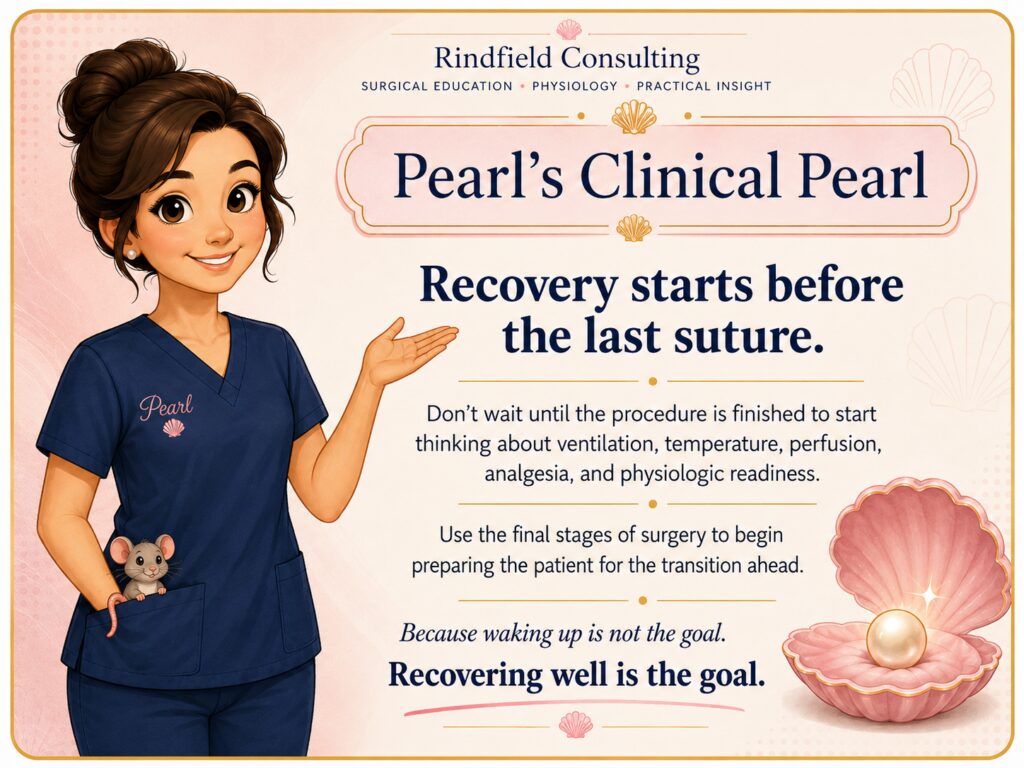
But successful recovery does not begin when surgery ends.
Recovery begins while the patient is still on the surgical table.
The decisions we make during those final stages of a procedure—how we manage ventilation, temperature, circulation, analgesia, anesthetic depth, and physiologic stability—help determine what that recovery is going to look like.
That is why I think of recovery as an active phase of surgery, not an afterthought.
The Transition Starts Before the Last Suture
As a procedure begins winding down, my thinking begins to change.
During the main surgical portion of the procedure, I may be asking:
Is anesthesia adequate?
Is blood pressure stable?
Is ventilation appropriate?
Are we maintaining temperature?
How is perfusion?
What is happening surgically?
Toward the end of the case, another question gets added:
What does this patient need in order to recover well?
That question should be asked before the final suture.
Because by the time the procedure is technically finished, I want the patient’s physiology already moving in the right direction.
Current laboratory-animal guidance emphasizes that monitoring should continue through anesthetic recovery, with particular attention to thermoregulation, cardiovascular and respiratory function, hydration, and postoperative pain or discomfort.
Ventilator Weaning Is Not an On/Off Switch
One of the most important transitions in a mechanically ventilated patient is moving from controlled ventilation back toward spontaneous breathing.
That should not be treated as:
Ventilator on.
Ventilator off.
Hope for the best.
Instead, we should be watching the patient participate in that transition.
Is spontaneous respiratory effort returning?
What is happening with respiratory rate and pattern?
What does the capnogram look like?
Is ETCO₂ changing?
Is chest excursion appropriate?
Is oxygenation being maintained?
Does the patient appear capable of sustaining ventilation rather than simply producing an occasional breath?
And importantly:
Is what I am seeing actually effective ventilation?
Chest movement alone does not necessarily answer that question.
This is where capnography becomes extraordinarily useful.
A respiratory movement tells me that an effort occurred.
The capnogram helps tell me whether gas is actually moving.
The rest of the patient’s physiology helps complete the picture.
Recovery Is Still a Physiologic Conversation
This is where the philosophy behind physiologic monitoring becomes especially important.
We should not evaluate recovery based on one parameter.
A patient beginning to breathe spontaneously may still be cold.
A patient with an acceptable heart rate may still have poor peripheral perfusion.
A patient moving or becoming more responsive may still have inadequate ventilation.
A patient whose monitor values look reasonable may still require closer observation before being considered physiologically ready for the next step.
So we continue listening.
Heart rate.
Blood pressure.
Capnography.
Temperature.
Perfusion.
Respiratory pattern.
Oxygenation.
Patient movement and responsiveness.
The question remains the same:
What is the patient trying to tell me?
Temperature Can Change the Entire Recovery
Temperature deserves special attention during the transition out of anesthesia.
Anesthetic procedures can interfere with normal thermoregulation, and smaller laboratory animals are particularly susceptible to perioperative heat loss. Experimental work in mice has also demonstrated the importance of active thermal support during anesthesia and recovery.
That means warming should not suddenly become important when the patient reaches the recovery area.
It should have been part of the plan throughout the procedure.
And toward the end of surgery, I want to know more than:
“What is the temperature?”
I also want to know:
Is it stable?
Is it rising?
Is it still drifting downward?
Can the patient begin maintaining temperature without increasingly aggressive support?
Again, the trend matters.
A patient that is gradually warming is telling us a different story than one whose temperature continues to fall.
Look at Perfusion, Not Just Blood Pressure
Blood pressure is important.
But blood pressure and perfusion are not interchangeable concepts.
During recovery, I still want to look at the entire patient.
Are the extremities warm?
Has tissue color changed?
Is there evidence of compromised circulation?
If vascular manipulation occurred during surgery, is perfusion symmetrical where appropriate?
What happened to blood pressure during the procedure?
Was there significant blood loss?
Did the patient require cardiovascular support?
And what direction are those variables moving now?
Sometimes the monitor gives us the first clue.
Sometimes the patient does.
The strongest assessment comes from using both.
Think Ahead About Analgesia
The transition out of anesthesia is also not the ideal moment to suddenly remember postoperative pain management.
Analgesic planning belongs before recovery.
The goal is to have an appropriate, protocol-approved analgesic plan in place so that pain control does not depend entirely on maintaining a deeper plane of general anesthesia until the very end.
Good postoperative care includes attention to pain and discomfort during the immediate anesthetic-recovery period, and the appropriate plan varies by species, procedure, research objectives, veterinary direction, and approved protocol.
Recovery should not become a race to wake the patient up.
It should be a controlled transition from one physiologic state to another.
Extubation Should Be a Decision, Not a Habit
It is easy to develop routines around extubation.
We see a particular movement.
We wait a certain amount of time.
We reach a familiar point in the procedure.
And we remove the tube.
But extubation should be based on the individual patient’s readiness and the criteria appropriate for that species, procedure, anesthetic technique, and institutional protocol.
Before removing respiratory support, ask:
What evidence do I have that this patient is ready?
Not:
“Is this usually when we extubate?”
Those are very different questions.
Guidance for laboratory-animal recovery specifically emphasizes ensuring that control of respiration has returned before an animal is returned to routine housing or less intensive observation.
Don’t Stop Watching Because the Surgery Is Finished
There is a natural sense of relief when the final suture is placed.
The technically difficult part is over.
But physiologically, the patient may now be entering one of the most dynamic portions of the entire procedure.
Anesthetic concentrations are changing.
Ventilatory support may be changing.
Body temperature is adjusting.
The patient may begin moving.
Cardiovascular tone may change.
Pain perception may become more relevant as anesthetic depth decreases.
The airway may soon transition from controlled to patient-maintained.
That is not the moment to decrease vigilance simply because the surgical instruments are being put away.
Immediate anesthetic recovery is recognized as a period that may require more intensive observation than later postoperative recovery.
Active Recovery Means Having a Plan
For me, active recovery means thinking ahead.
Before surgery is completely finished, I want to know:
- Is temperature where I want it to be, and what direction is it moving?
- Is cardiovascular function stable?
- How is perfusion?
- Is adequate spontaneous ventilation returning?
- What is the capnogram telling me?
- Is oxygenation appropriate?
- Is postoperative analgesia addressed?
- Are there surgical concerns that need additional monitoring?
- What findings would make me delay the next step?
- Who is responsible for observing the patient during the transition?
That last question matters.
Recovery should have ownership.
Someone should be actively watching the patient, recognizing changes, documenting important observations, and responding when needed.
A Successful Surgery Includes a Successful Recovery
Technical surgical success matters.
Of course it does.
But placing an implant perfectly, completing a vascular catheterization successfully, or closing an incision beautifully is only part of the outcome in a survival procedure.
The patient still has to recover.
And what happens during recovery can affect animal welfare, postoperative complications, study quality, and ultimately the usefulness of the scientific data.
That is why I don’t consider recovery separate from surgery.
Recovery is part of the surgery.
And when we begin preparing for it before the final suture is placed, we give ourselves time to recognize problems while we still have every monitoring tool, every piece of equipment, and the entire surgical team immediately available.
The patient is always talking.
Our job is to learn the language.
— Rindfield Consulting